Thursday, February 26, 2015

The boy and the Starfish:

A man was walking along a deserted beach at sunset. As he walked he could see a young boy in the distance, as he drew nearer he noticed that the boy kept bending down, picking something up and throwing it into the water.
Time and again he kept hurling things into the ocean.
As the man approached even closer, he was able to see that the boy was picking up starfish that had been washed up on the beach and, one at a time he was throwing them back into the water.
The man asked the boy what he was doing, the boy replied,"I am throwing these washed up starfish back into the ocean, or else they will die through lack of oxygen. "But", said the man, "You can't possibly save them all, there are thousands on this beach, and this must be happening on hundreds of beaches along the coast. You can't possibly make a difference."

The boy looked down, frowning for a moment; then bent down to pick up another starfish, smiling as he threw it back into the sea. He replied, 

"I made a huge difference to that one!" 

Saturday, February 21, 2015

Exponential Economist Meets Finite Physicist

Exponential Economist Meets Finite Physicist

Some while back, I found myself sitting next to an accomplished economics professor at a dinner event. Shortly after pleasantries, I said to him, “economic growth cannot continue indefinitely,” just to see where things would go. It was a lively and informative conversation. I was somewhat alarmed by the disconnect between economic theory and physical constraints—not for the first time, but here it was up-close and personal. Though my memory is not keen enough to recount our conversation verbatim, I thought I would at least try to capture the key points and convey the essence of the tennis match—with some entertainment value thrown in.
Cast of characters: Physicist, played by me; Economist, played by an established economics professor from a prestigious institution. Scene: banquet dinner, played in four acts (courses).
Note: because I have a better retention of my own thoughts than those of my conversational companion, this recreation is lopsided to represent my own points/words. So while it may look like a physicist-dominated conversation, this is more an artifact of my own recall capabilities. I also should say that the other people at our table were not paying attention to our conversation, so I don’t know what makes me think this will be interesting to readers if it wasn’t even interesting enough to others at the table! But here goes…

Act One: Bread and Butter

Physicist: Hi, I’m Tom. I’m a physicist.
Economist: Hi Tom, I’m [ahem..cough]. I’m an economist.
Physicist: Hey, that’s great. I’ve been thinking a bit about growth and want to run an idea by you. I claim that economic growth cannot continue indefinitely.
Economist: [chokes on bread crumb] Did I hear you right? Did you say that growth can not continue forever?
Physicist: That’s right. I think physical limits assert themselves.
Economist: Well sure, nothing truly lasts forever. The sun, for instance, will not burn forever. On the billions-of-years timescale, things come to an end.
Physicist: Granted, but I’m talking about a more immediate timescale, here on Earth. Earth’s physical resources—particularly energy—are limited and may prohibit continued growth within centuries, or possibly much shorter depending on the choices we make. There are thermodynamic issues as well.
Economist: I don’t think energy will ever be a limiting factor to economic growth. Sure, conventional fossil fuels are finite. But we can substitute non-conventional resources like tar sands, oil shale, shale gas, etc. By the time these run out, we’ll likely have built up a renewable infrastructure of wind, solar, and geothermal energy—plus next-generation nuclear fission and potentially nuclear fusion. And there are likely energy technologies we cannot yet fathom in the farther future.
Physicist: Sure, those things could happen, and I hope they do at some non-trivial scale. But let’s look at the physical implications of the energy scale expanding into the future. So what’s a typical rate of annual energy growth over the last few centuries?
Economist: I would guess a few percent. Less than 5%, but at least 2%, I should think.
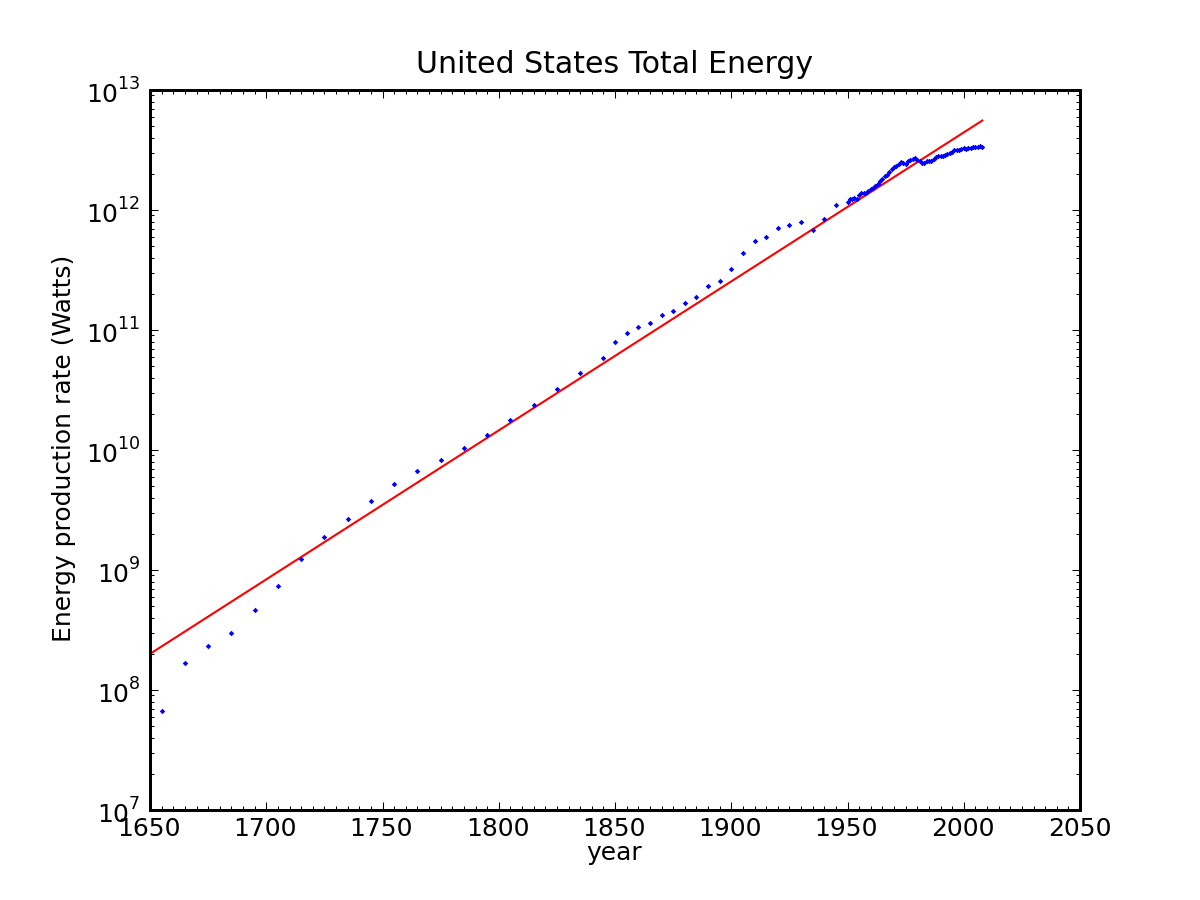
U.S. total energy 1650-present (logarithmic)
Total U.S. Energy consumption in all forms since 1650. The vertical scale is logarithmic, so that an exponential curve resulting from a constant growth rate appears as a straight line. The red line corresponds to an annual growth rate of 2.9%. Source: EIA.
Physicist: Right, if you plot the U.S. energy consumption in all forms from 1650 until now, you see a phenomenally faithful exponential at about 3% per year over that whole span. The situation for the whole world is similar. So how long do you think we might be able to continue this trend?
Economist: Well, let’s see. A 3% growth rate means a doubling time of something like 23 years. So each century might see something like a 15–20× increase. I see where you’re going. A few more centuries like that would perhaps be absurd. But don’t forget that population was increasing during centuries past—the period on which you base your growth rate. Population will stop growing before more centuries roll by.
Physicist: True enough. So we would likely agree that energy growth will not continue indefinitely. But two points before we continue: First, I’ll just mention that energy growth has far outstripped population growth, so that per-capita energy use has surged dramatically over time—our energy lives today are far richer than those of our great-great-grandparents a century ago [economist nods]. So even if population stabilizes, we are accustomed to per-capita energy growth: total energy would have to continue growing to maintain such a trend [another nod].
Second, thermodynamic limits impose a cap to energy growth lest we cook ourselves. I’m not talking about global warming, CO2 build-up, etc. I’m talking about radiating the spent energy into space. I assume you’re happy to confine our conversation to Earth, foregoing the spectre of an exodus to space, colonizing planets, living the Star Trek life, etc.
Economist: More than happy to keep our discussion grounded to Earth.
Physicist: [sigh of relief: not a space cadet] Alright, the Earth has only one mechanism for releasing heat to space, and that’s via (infrared) radiation. We understand the phenomenon perfectly well, and can predict the surface temperature of the planet as a function of how much energy the human race produces. The upshot is that at a 2.3% growth rate (conveniently chosen to represent a 10× increase every century), we would reach boiling temperature in about 400 years. [Pained expression from economist.] And this statement is independent of technology. Even if we don’t have a name for the energy source yet, as long as it obeys thermodynamics, we cook ourselves with perpetual energy increase.
Economist: That’s a striking result. Could not technology pipe or beam the heat elsewhere, rather than relying on thermal radiation?
Physicist: Well, we could (and do, somewhat) beam non-thermal radiation into space, like light, lasers, radio waves, etc. But the problem is that these “sources” are forms of high-grade, low-entropy energy. Instead, we’re talking about getting rid of the waste heat from all the processes by which we use energy. This energy is thermal in nature. We might be able to scoop up some of this to do useful “work,” but at very low thermodynamic efficiency. If you want to use high-grade energy in the first place, having high-entropy waste heat is pretty inescapable.
Economist: [furrowed brow] Okay, but I still think our path can easily accommodate at least a steady energy profile. We’ll use it more efficiently and for new pursuits that continue to support growth.
Physicist: Before we tackle that, we’re too close to an astounding point for me to leave it unspoken. At that 2.3% growth rate, we would be using energy at a rate corresponding to the total solar input striking Earth in a little over 400 years. We would consume something comparable to the entire sun in 1400 years from now. By 2500 years, we would use energy at the rate of the entire Milky Way galaxy—100 billion stars! I think you can see the absurdity of continued energy growth. 2500 years is not that long, from a historical perspective. We know what we were doing 2500 years ago. I think I know what we’re not going to be doing 2500 years hence.
Economist: That’s really remarkable—I appreciate the detour. You said about 1400 years to reach parity with solar output?
Physicist: Right. And you can see the thermodynamic point in this scenario as well. If we tried to generate energy at a rate commensurate with that of the Sun in 1400 years, and did this on Earth, physics demands that the surface of the Earth must be hotter than the (much larger) surface of the Sun. Just like 100 W from a light bulb results in a much hotter surface than the same 100 W you and I generate via metabolism, spread out across a much larger surface area.
Economist: I see. That does make sense.

Act Two: Salad

Economist: So I’m as convinced as I need to be that growth in raw energy use is a limited proposition—that we must one day at the very least stabilize to a roughly constant yearly expenditure. At least I’m willing to accept that as a starting point for discussing the long term prospects for economic growth. But coming back to your first statement, I don’t see that this threatens the indefinite continuance of economic growth.
For one thing, we can keep energy use fixed and still do more with it in each passing year via efficiency improvements. Innovations bring new ideas to the market, spurring investment, market demand, etc. These are things that will not run dry. We have plenty of examples of fundamentally important resources in decline, only to be substituted or rendered obsolete by innovations in another direction.
Physicist: Yes, all these things happen, and will continue at some level. But I am not convinced that they represent limitless resources.
Economist: Do you think ingenuity has a limit—that the human mind itself is only so capable? That could be true, but we can’t credibly predict how close we might be to such a limit.
Physicist: That’s not really what I have in mind. Let’s take efficiency first. It is true that, over time, cars get better mileage, refrigerators use less energy, buildings are built more smartly to conserve energy, etc. The best examples tend to see factor-of-two improvements on a 35 year timeframe, translating to 2% per year. But many things are already as efficient as we can expect them to be. Electric motors are a good example, at 90% efficiency. It will always take 4184 Joules to heat a liter of water one degree Celsius. In the middle range, we have giant consumers of energy—like power plants—improving much more slowly, at 1% per year or less. And these middling things tend to be something like 30% efficient. How many more “doublings” are possible? If many of our devices were 0.01% efficient, I would be more enthusiastic about centuries of efficiency-based growth ahead of us. But we may only have one more doubling in us, taking less than a century to realize.
Economist: Okay, point taken. But there is more to efficiency than incremental improvement. There are also game-changers. Tele-conferencing instead of air travel. Laptop replaces desktop; iPhone replaces laptop, etc.—each far more energy frugal than the last. The internet is an example of an enabling innovation that changes the way we use energy.
Physicist: These are important examples, and I do expect some continuation along this line, but we still need to eat, and no activity can get away from energy use entirely. [semi-reluctant nod/bobble] Sure, there are lower-intensity activities, but nothing of economic value is completely free of energy.
Economist: Some things can get awfully close. Consider virtualization. Imagine that in the future, we could all own virtual mansions and have our every need satisfied: all by stimulative neurological trickery. We would stil need nutrition, but the energy required to experience a high-energy lifestyle would be relatively minor. This is an example of enabling technology that obviates the need to engage in energy-intensive activities. Want to spend the weekend in Paris? You can do it without getting out of your chair. [More like an IV-drip-equipped toilet than a chair, the physicist thinks.]
Physicist: I see. But this is still a finite expenditure of energy per person. Not only does it take energy to feed the person (today at a rate of 10 kilocalories of energy input per kilocalorie eaten, no less), but the virtual environment probably also requires a supercomputer—by today’s standards—for every virtual voyager. The supercomputer at UCSD consumes something like 5 MW of power. Granted, we can expect improvement on this end, but today’s supercomputer eats 50,000 times as much as a person does, so there is a big gulf to cross. I’ll take some convincing. Plus, not everyone will want to live this virtual existence.
Economist: Really? Who could refuse it? All your needs met and an extravagant lifestyle—what’s not to like? I hope I can live like that myself someday.
Physicist: Not me. I suspect many would prefer the smell of real flowers—complete with aphids and sneezing; the feel of real wind messing up their hair; even real rain, real bee-stings, and all the rest. You might be able to simulate all these things, but not everyone will want to live an artificial life. And as long as there are any holdouts, the plan of squeezing energy requirements to some arbitrarily low level fails. Not to mention meeting fixed bio-energy needs.

Act Three: Main Course

Physicist: But let’s leave the Matrix, and cut to the chase. Let’s imagine a world of steady population and steady energy use. I think we’ve both agreed on these physically-imposed parameters. If the flow of energy is fixed, but we posit continued economic growth, then GDP continues to grow while energy remains at a fixed scale. This means that energy—a physically-constrained resource, mind—must become arbitrarily cheap as GDP continues to grow and leave energy in the dust.
Economist: Yes, I think energy plays a diminishing role in the economy and becomes too cheap to worry about.
Physicist: Wow. Do you really believe that? A physically limited resource (read scarcity) that is fundamental to every economic activity becomes arbitrarily cheap? [turns attention to food on the plate, somewhat stunned]
Economist: [after pause to consider] Yes, I do believe that.
Physicist: Okay, so let’s be clear that we’re talking about the same thing. Energy today is roughly 10% of GDP. Let’s say we cap the physical amount available each year at some level, but allow GDP to keep growing. We need to ignore inflation as a nuisance in this case: if my 10 units of energy this year costs $10,000 out of my $100,000 income; then next year that same amount of energy costs $11,000 and I make $110,000—I want to ignore such an effect as “meaningless” inflation: the GDP “growth” in this sense is not real growth, but just a re-scaling of the value of money.
Economist: Agreed.
Physicist: Then in order to have real GDP growth on top of flat energy, the fractional cost of energy goes down relative to the GDP as a whole.
Economist: Correct.
Physicist: How far do you imagine this can go? Will energy get to 1% of GDP? 0.1%? Is there a limit?
Economist: There does not need to be. Energy may become of secondary importance in the economy of the future—like in the virtual world I illustrated.
Physicist: But if energy became arbitrarily cheap, someone could buy all of it, and suddenly the activities that comprise the economy would grind to a halt. Food would stop arriving at the plate without energy for purchase, so people would pay attention to this. Someone would be willing to pay more for it. Everyone would. There will be a floor to how low energy prices can go as a fraction of GDP.
Economist: That floor may be very low: much lower than the 5–10% we pay today.
Physicist: But is there a floor? How low are you willing to take it? 5%? 2%? 1%?
Economist: Let’s say 1%.
Physicist: So once our fixed annual energy costs 1% of GDP, the 99% remaining will find itself stuck. If it tries to grow, energy prices must grow in proportion and we have monetary inflation, but no real growth.
Economist: Well, I wouldn’t go that far. You can still have growth without increasing GDP.
Physicist: But it seems that you are now sold on the notion that the cost of energy would not naturally sink to arbitrarily low levels.
Economist: Yes, I have to retract that statement. If energy is indeed capped at a steady annual amount, then it is important enough to other economic activities that it would not be allowed to slip into economic obscurity.
Physicist: Even early economists like Adam Smith foresaw economic growth as a temporary phase lasting maybe a few hundred years, ultimately limited by land (which is where energy was obtained in that day). If humans are successful in the long term, it is clear that a steady-state economic theory will far outlive the transient growth-based economic frameworks of today. Forget Smith, Keynes, Friedman, and that lot. The economists who devise a functioning steady-state economic system stand to be remembered for a longer eternity than the growth dudes. [Economist stares into the distance as he contemplates this alluring thought.]

Act Four: Dessert

Economist: But I have to object to the statement that growth must stop once energy amount/price saturates. There will always be innovations that people are willing to purchase that do not require additional energy.
Physicist: Things will certainly change. By “steady-state,” I don’t mean static. Fads and fashions will always be part of what we do—we’re not about to stop being human. But I’m thinking more of a zero-sum game here. Fads come and go. Some fraction of GDP will always go toward the fad/innovation/gizmo of the day, but while one fad grows, another fades and withers. Innovation therefore will maintain a certain flow in the economy, but not necessarily growth.
Economist: Ah, but the key question is whether life 400 years from now is undeniably of higher quality than life today. Even if energy is fixed, and GDP is fixed once the cost of energy saturates at the lower bound, will quality of life continue to improve in objectively agreed-upon ways?
Physicist: I don’t know how objective such an assessment can be. Many today yearn for days past. Maybe this is borne of ignorance or romanticism over the past (1950′s often comes up). It may be really exciting to imagine living in Renaissance Europe, until a bucket of nightsoil hurled from a window splatters off the cobblestone and onto your breeches. In any case, what kind of universal, objective improvements might you imagine?
Economist: Well, for instance, look at this dessert, with its decorative syrup swirls on the plate. It is marvelous to behold.
Physicist: And tasty.
Economist: We value such desserts more than plain, unadorned varieties. In fact, we can imagine an equivalent dessert with equivalent ingredients, but the decorative syrup unceremoniously pooled off to one side. We value the decorated version more. And the chefs will continue to innovate. Imagine a preparation/presentation 400 years from now that would blow your mind—you never thought dessert could be made to look so amazing and taste so delectably good. People would line the streets to get hold of such a creation. No more energy, no more ingredients, yet of increased value to society. That’s a form of quality of life improvement, requiring no additional resources, and perhaps costing the same fraction of GDP, or income.
Physicist: I’m smiling because this reminds me of a related story. I was observing at Palomar Observatory with an amazing instrumentation guru named Keith who taught me much. Keith’s night lunch—prepared in the evening by the observatory kitchen and placed in a brown bag—was a tuna-fish sandwich in two parts: bread slices in a plastic baggie, and the tuna salad in a small plastic container (so the tuna would not make the bread soggy after hours in the bag). Keith plopped the tuna onto the bread in an inverted container-shaped lump, then put the other piece of bread on top without first spreading the tuna. It looked like a snake had just eaten a rat. Perplexed, I asked if he intended to spread the tuna before eating it. He looked at me quizzically (like Morpheus in the Matrix: “You think that’s air you’re breathing? Hmm.”), and said—memorably, “It all goes in the same place.”
My point is that the stunning presentation of desserts will not have universal value to society. It all goes in the same place, after all. [I'll share a little-known secret. It's hard to beat a Hostess Ding Dong for dessert. At 5% the cost of fancy desserts, it's not clear how much value the fancy things add.]

After-Dinner Contemplations

The evening’s after-dinner keynote speech began, so we had to shelve the conversation. Reflecting on it, I kept thinking, “This should not have happened. A prominent economist should not have to walk back statements about the fundamental nature of growth when talking to a scientist with no formal economics training.” But as the evening progressed, the original space in which the economist roamed got painted smaller and smaller.
First, he had to acknowledge that energy may see physical limits. I don’t think that was part of his initial virtual mansion.
Next, the efficiency argument had to shift away from straight-up improvements to transformational technologies. Virtual reality played a prominent role in this line of argument.
Finally, even having accepted the limits to energy growth, he initially believed this would prove to be of little consequence to the greater economy. But he had to ultimately admit to a floor on energy price and therefore an end to traditional growth in GDP—against a backdrop fixed energy.
I got the sense that this economist’s view on growth met some serious challenges during the course of the meal. Maybe he was not putting forth the most coherent arguments that he could have made. But he was very sharp and by all measures seemed to be at the top of his game. I choose to interpret the episode as illuminating a blind spot in traditional economic thinking. There is too little acknowledgement of physical limits, and even the non-compliant nature of humans, who may make choices we might think to be irrational—just to remain independent and unencumbered.
I recently was motivated to read a real economics textbook: one written by people who understand and respect physical limitations. The book, called Ecological Economics, by Herman Daly and Joshua Farley, states in its Note to Instructors:
…we do not share the view of many of our economics colleagues that growth will solve the economic problem, that narrow self-interest is the only dependable human motive, that technology will always find a substitute for any depleted resource, that the market can efficiently allocate all types of goods, that free markets always lead to an equilibrium balancing supply and demand, or that the laws of thermodynamics are irrelevant to economics.
This is a book for me!

Epilogue

The conversation recreated here did challenge my own understanding as well. I spent the rest of the evening pondering the question: “Under a model in which GDP is fixed—under conditions of stable energy, stable population, steady-state economy: if we accumulate knowledge, improve the quality of life, and thus create an unambiguously more desirable world within which to live, doesn’t this constitute a form of economic growth?”
I had to concede that yes—it does. This often falls under the title of “development” rather than “growth.” I ran into the economist the next day and we continued the conversation, wrapping up loose ends that were cut short by the keynote speech. I related to him my still-forming position that yes, we can continue tweaking quality of life under a steady regime. I don’t think I ever would have explicitly thought otherwise, but I did not consider this to be a form of economic growth. One way to frame it is by asking if future people living in a steady-state economy—yet separated by 400 years—would always make the same, obvious trades? Would the future life be objectively better, even for the same energy, same GDP, same income, etc.? If the answer is yes, then the far-future person gets more for their money: more for their energy outlay. Can this continue indefinitely (thousands of years)? Perhaps. Will it be at the 2% per year level (factor of ten better every 100 years)? I doubt that.
So I can twist my head into thinking of quality of life development in an otherwise steady-state as being a form of indefinite growth. But it’s not your father’s growth. It’s not growing GDP, growing energy use, interest on bank accounts, loans, fractional reserve money, investment. It’s a whole different ballgame, folks. Of that, I am convinced. Big changes await us. An unrecognizable economy. The main lesson for me is that growth is not a “good quantum number,” as physicists will say: it’s not an invariant of our world. Cling to it at your own peril.

 http://www.resilience.org/stories/2012-04-11/exponential-economist-meets-finite-physicist

Friday, February 20, 2015

Modern men

My modern Indian man - 


A hugging man - 

1. A man who is first the biggest friend to his child. Not a figure of authority.  A man who hugs his son! I write this in bold because I know very few men who hug their sons or fathers. Sad truth. 

2.  A father who plaits his daughter's hair - 
2. A man who embraces his metro sexuality openly. A man who knows that taking  care of his hair and skin isn't beneath him. 

3. A man who isn't threatened by a woman's intelligence or beauty. But rather revels in it! 

4. A man who takes equal pleasure and responsibility in taking care of the chores at home as well as the baby. 

5. A man who is open.  A man who isn't ashamed of his passions. A man who strives to learn something new without any prejudices. 

6. A man who takes every effort to demonstrate his love. Someone who doesn't think that expressing will make him weak. 

7. A man who is rational and independent thinker. A man who is questioning. A man with a scientific temper. 

8. A man who asks for help when in need.

So you see my modern Indian man isn't very different from my idea of a modern Indian woman. Except the metro-sexuality and hugging. Women are a little more generous with hugging their mothers! ;)

Sunday, January 11, 2015

Mind expanding books 2

  1. Why Does the World Exist? - Jim Holt

    It asks the question "Why is there a world when there should be nothing?" It is related to metaphysics. It is also tinged with philosophy and is quite a good read.
  2. Bulfinch's Mythology - Thomas Bulfinch

    This book retells the Greek Myths in all their glory. Learn about Zeus, Venus, Hera and other Olympian Gods. These gods are fallible too. After reading this book, you will have a greater understanding of the Greek mythology. It is also interspersed with Roman Mythology.
  3. Supernormal: Science, Yoga and the Evidence for Extraordinary abilities - Dean Radin

    Can yoga and meditation unleash our inherent supernormal mental powers, such as telepathy, clairvoyance, and precognition? Is it really possible to perceive another person's thoughts and intentions? Influence objects with our minds? Envision future events? And is it possible that some of the superpowers described in ancient legends, science fiction, and comic books are actually real, and patiently waiting for us behind the scenes? Are we now poised for an evolutionary trigger to pull the switch and release our full potentials? These and many more questions are answered in this book. It is certainly a very engrossing read.
  4. Alone Together - Sherry Turkle

    In Alone Together, MIT technology and society professor Sherry Turkle explores the power of our new tools and toys to dramatically alter our social lives. It’s a nuanced exploration of what we are looking for—and sacrificing—in a world of electronic companions and social networking tools, and an argument that, despite the hand-waving of today’s self-described prophets of the future, it will be the next generation who will chart the path between isolation and connectivity.
  5. The Paradox of Choice: Why More is Less - Barry Schwartz

    In The Paradox of Choice, Barry Schwartz explains at what point choice--the hallmark of individual freedom and self-determination that we so cherish--becomes detrimental to our psychological and emotional well-being. In accessible, engaging, and anecdotal prose, Schwartz shows how the dramatic explosion in choice--from the mundane to the profound challenges of balancing career, family, and individual needs--has paradoxically become a problem instead of a solution. Schwartz also shows how our obsession with choice encourages us to seek that which makes us feel worse.
  6. The Purity Myth: How America's Obsession with Virginity is Hurting Young Women - Jessica Valent

    The Purity Myth presents a revolutionary argument that girls and women are overly valued for their sexuality, as well as solutions for a future without a damaging emphasis on virginity.
  7. Prisoner's Dilemma - William Poundstone

    A layman's introduction to Game Theory. It is based on the work by Von Neumann. And its thoroughly interesting.
  8. The Ethical Brain: The Science of our Moral Dilemmas - Michael S. Gazzaniga

    In The Ethical Brain, preeminent neuroscientist Michael S. Gazzaniga presents the emerging social and ethical issues arising out of modern-day brain science and challenges the way we look at them. Courageous and thought-provoking -- a work of enormous intelligence, insight, and importance -- this book explores the hitherto uncharted landscape where science and society intersect
  9. Resource Wars: The New Landscape of Global Conflict - Michael Klare

    International security expert Michael T. Klare argues that in the early decades of the new millennium, wars will be fought not over ideology but over access to dwindling supplies of precious natural commodities. The political divisions of the Cold War, Klare asserts, have given way to a global scramble for oil, natural gas, minerals, and water. And as armies throughout the world define resource security as a primary objective, widespread instability is bound to follow, especially in those areas where competition for essential materials overlaps with long-standing territorial and religious disputes. In this clarifying view, the recent explosive conflict between the United States and Islamic extremism stands revealed as the predictable consequence of consumer nations seeking to protect the vital resources they depend on.
  10. The Bottom Billion: Why the Poorest Countries are Failing And What Can Be Done About It? - Paul Collier

    In the universally acclaimed and award-winning The Bottom Billion, Paul Collier reveals that fifty failed states--home to the poorest one billion people on Earth--pose the central challenge of the developing world in the twenty-first century. The book shines much-needed light on this group of small nations, largely unnoticed by the industrialized West, that are dropping further and further behind the majority of the world's people, often falling into an absolute decline in living standards.
  11. The Ascent Of Money - Niall Fergusson

    Niall Ferguson follows the money to tell the human story behind the evolution of finance, from its origins in ancient Mesopotamia to the latest upheavals on what he calls Planet Finance.
  12. The Rational Optimist: How Prosperity Evolves

    Matt Ridley does more than describe how things are getting better. He explains why. Prosperity comes from everybody working for everybody else. The habit of exchange and specialization—which started more than 100,000 years ago—has created a collective brain that sets human living standards on a rising trend. The mutual dependence, trust, and sharing that result are causes for hope, not despair.
  13. The Code Breakers - David Kahn

    The magnificent, unrivaled history of codes and ciphers -- how they're made, how they're broken, and the many and fascinating roles they've played since the dawn of civilization in war, business, diplomacy, and espionage.
  14. The Revenge of Geography - Robert Kaplan

    In The Revenge of Geography, Kaplan builds on the insights, discoveries, and theories of great geographers and geopolitical thinkers of the near and distant past to look back at critical pivots in history and then to look forward at the evolving global scene.
  15. Justice: Whats The Right Thing To Do - Michael Sandel

    What are our obligations to others as people in a free society? Should government tax the rich to help the poor? Is the free market fair? Is it sometimes wrong to tell the truth? Is killing sometimes morally required? Is it possible, or desirable, to legislate morality? Do individual rights and the common good conflict?

    These questions are at the core of our public life today—and at the heart of Justice, in which Michael J. Sandel shows how a surer grasp of philosophy can help us to make sense of politics, morality, and our own convictions as well.
  16. Mind Wars - Jonathan Moreno

    Jonathan D. Moreno investigates the deeply intertwined worlds of cutting-edge brain science, U.S. defense agencies, and a volatile geopolitical landscape where a nation's weaponry must go far beyond bombs and men. The first-ever exploration of the connections between national security and brain research, Mind Wars: Brain Research and National Defensereveals how many questions crowd this gray intersection of science and government and urges us to begin to answer them.
  17. The Myth of The Rational Voter - Bryan Caplan

    The greatest obstacle to sound economic policy is not entrenched special interests or rampant lobbying, but the popular misconceptions, irrational beliefs, and personal biases held by ordinary voters. This is economist Bryan Caplan's sobering assessment in this provocative and eye-opening book. Caplan argues that voters continually elect politicians who either share their biases or else pretend to, resulting in bad policies winning again and again by popular demand.
  18. The Rise and Fall of the British Empire - James Lawrence

    Great Britain's geopolitical role has undergone many changes over the last four centuries. Once a maritime superpower and ruler of half the world, Britain now occupies an isolated position as an economically fragile island often at odds with her European neighbors.
    Lawrence James has written a comprehensive, perceptive, and insighful history of the British Empire. Spanning the years from 1600 to the present day, this critically acclaimed book combines detailed scholarship with readable popular history.
  19. The Nazi Doctors: Medical Killing And the Psychology of Genocide - Robert Jay Lifton

    Nazi doctors did more than conduct bizarre experiments on concentration-camp inmates; they supervised the entire process of medical mass murder, from selecting those who were to be exterminated to disposing of corpses. Lifton (The Broken Connection; The Life of the Self shows that this medically supervised killing was done in the name of "healing," as part of a racist program to cleanse the Aryan body politic).
  20. Civilization: The West and The Rest - Niall Fergusson

    What was it about the civilization of Western Europe that allowed it to trump the outwardly superior empires of the Orient? The answer, Niall Ferguson argues, was that the West developed six "killer applications"?that the Rest lacked: competition, science, democracy, medicine, consumerism and the work ethic. The key question today is whether or not the West has lost its monopoly on these six things. If so, Ferguson warns, we may be living through the end of Western ascendancy.
  21. Influencer: The Power to Change Anything - Kerry Patterson

    Influencing human behavior is one of the most difficult challenges faced by leaders. This book provides powerful insight into how to make behavior change that will last.
  22. Big Data - Kenneth Kukier

    “Big data” refers to our burgeoning ability to crunch vast collections of information, analyze it instantly, and draw sometimes profoundly surprising conclusions from it. This emerging science can translate myriad phenomena—from the price of airline tickets to the text of millions of books—into searchable form, and uses our increasing computing power to unearth epiphanies that we never could have seen before. A revolution on par with the Internet or perhaps even the printing press, big data will change the way we think about business, health, politics, education, and innovation in the years to come. It also poses fresh threats, from the inevitable end of privacy as we know it to the prospect of being penalized for things we haven’t even done yet, based on big data’s ability to predict our future behavior.
  23. The Fine Art Of Small Talk - Debra Fine

    The Fine Art of Small Talk will help you learn to feel more comfortable in any type of social situation, from lunch with the boss to an association event to a cocktail party where you don't know a soul.
  24. In Defense of Food: An Eater's Manifesto - Michael Pollan

    Pollan proposes a new answer to the question of what we should eat that comes down to seven simple but liberating words: Eat food. Not too much. Mostly plants. Pollan's bracing and eloquent manifesto shows us how we can start making thoughtful food choices that will enrich our lives, enlarge our sense of what it means to be healthy, and bring pleasure back to eating.
  25. The Sex Myth - Brooke Magnati

    Is there any truth to the epidemic of sex addiction? Are our children really getting sexualised younger? Are men the only ones who like porn? Brooke Magnanti looks at all these questions and more - and proves that perhaps we've all been taking the answers for granted.
  26. Sexual Politics in Modern Iran - Janet Afary

    Janet Afary is a native of Iran and a leading historian. Her work focuses on gender and sexuality and draws on her experience of growing up in Iran and her involvement with Iranian women of different ages and social strata. These observations, and a wealth of historical documents, form the kernel of this book, which charts the history of the nation's sexual revolution from the nineteenth century to today. What comes across is the extraordinary resilience of the Iranian people, who have drawn on a rich social and cultural heritage to defy the repression and hardship of the Islamist state and its predecessors. It is this resilience, the author concludes, which forms the basis of a sexual revolution taking place in Iran today, one that is promoting reforms in marriage and family laws, and demanding more egalitarian gender and sexual relations.
  27. One Minute to Midnight - Michael Dobbs

    In October 1962, at the height of the Cold War, the United States and the Soviet Union appeared to be sliding inexorably toward a nuclear conflict over the placement of missiles in Cuba. Veteran "Washington Post" reporter Michael Dobbs has pored over previously untapped American, Soviet, and Cuban sources to produce the most authoritative book yet on the Cuban missile crisis. In his hour-by-hour chronicle of those near-fatal days, Dobbs reveals some startling new incidents that illustrate how close we came to Armageddon.
  28. The Most Dangerous Place - Imtiaz Gul

    Imtiaz Gul, who knows the ins and outs of these groups and their leaders, tackles the toughest questions about the current situation: What can be done to bring the Pakistani Taliban under control? Who funds these militants and what are their links to Al Qaeda? Are they still supported by the ISI, Pakistan's all-powerful intelligence agency?
  29. Inside the Crosshairs: Snipers In Vietnam - Michael Lanning

    At the start of the war in Vietnam, the United States had no snipers; by the end of the war, Marine and army precision marksmen had killed more than 10,000 NVA and VC soldiers--the equivalent of an entire division--at the cost of under 20,000 bullets, proving that long-range shooters still had a place in the battlefield. Now noted military historian Michael Lee Lanning shows how U.S. snipers in Vietnam--combining modern technology in weapons, ammunition, and telescopes--used the experience and traditions of centuries of expert shooters to perfect their craft.
  30. Churchill's Secret War - Madhushree Mukherjee

     As journalist Madhusree Mukerjee reveals, at the same time that Churchill brilliantly opposed the barbarism of the Nazis, he governed India with a fierce resolve to crush its freedom movement and a profound contempt for native lives. A series of Churchill's decisions between 1940 and 1944 directly and inevitably led to the deaths of some three million Indians. The streets of eastern Indian cities were lined with corpses, yet instead of sending emergency food shipments Churchill used the wheat and ships at his disposal to build stockpiles for feeding postwar Britain and Europe.Combining meticulous research with a vivid narrative, and riveting accounts of personality and policy clashes within and without the British War Cabinet, Churchill's Secret War places this oft-overlooked tragedy into the larger context of World War II, India's fight for freedom, and Churchill's enduring legacy. Winston Churchill may have found victory in Europe, but, as this groundbreaking historical investigation reveals, his mismanagement facilitated by dubious advice from scientist and eugenicist Lord Cherwella devastated India and set the stage for the massive bloodletting that accompanied independence.
  31. God Created the Integers - Stephen Hawking

    Bestselling author and physicist Stephen Hawking explores the "masterpieces" of mathematics, 25 landmarks spanning 2,500 years and representing the work of 15 mathematicians, including Augustin Cauchy, Bernard Riemann, and Alan Turing. This extensive anthology allows readers to peer into the mind of genius by providing them with excerpts from the original mathematical proofs and results. It also helps them understand the progression of mathematical thought, and the very foundations of our present-day technologies. Each chapter begins with a biography of the featured mathematician, clearly explaining the significance of the result, followed by the full proof of the work, reproduced from the original publication.

These are what I think are mind expanding.

I'll add more as I remember.

Saturday, January 3, 2015

What have been the most influential books which increase awareness and/or understanding of how the world operates?


 The Selfish Gene - Richard Dawkins


Here's a list of books I've come across that fit this bill in my own idiosyncratic areas of interest:

International conflict

  • Man, the State, and War by Kenneth Waltz
  • Theory of International Politics by Kenneth Waltz. Waltz is arguably the greatest mind in international relations in our lifetime. These are two amazing books about how international relations really work. Absolutely required reading.
  • History of the Peloponnesian War by Thucydides. Other than Waltz, the other book to read.
  • The Gathering Storm: first volume of Winston Churchill's WWII memoirs. This book is awesome.

Non-US cultures
  • Born Red: A Chronicle of the Cultural Revolution. Wow this is an amazingly insightful story of the Cultural Revolution, told first hand.
  • From Beirut to Jerusalem by Tom Friedman: This book is a little out of date now, but an incredible overview of Middle East history and cultural conflicts. One of my favorite 100 books.

American politics
  • Presidential Power by Richard Neustadt. Amazing overview of White House politics.
  • Congress: The Electoral Connection by David Mayhew.
  • Congress and The Bureaucracy by Douglas Arnold.
  • The Brethren by Bob Woodward. Great Supreme Court overview.
  • Federalist Papers. Very readable (surprisingly). Great recap of all the big issues behind the making of the U.S. Constitution.

Game theory and economics
  • Strategy of Conflict by Thomas Schelling. My favorite overview of game theory. Has lots of practical examples.
  • A Course in Microeconomic Theory by David Kreps. Not easy for non-economists, but good.

Other
  • Real and Functional Analysis by Serge Lang. If you're trying to understand analysis, this is pretty great.
  • A First Course in Probability by Sheldon Ross.
  • Stickney and Weil: Financial Accounting. Really lucid overview of accounting. You can teach yourself with this book.

Most of these topics (Middle East politics, Cultural Revolution, real analysis, accounting) are about fields/topics which are really difficult to grasp as a beginner. Each of these books put a giant smile on my face re: illuminating a black box that I cared about.


 Wow, what a great question!  It suddenly occurs to me that I've spent the last ten years of my life answering just this question...

I've found the following books particularly useful in trying to understand the world.  (And I'm an independent teacher, so I get to talk about many of these books all the time — I live a good life!)

Starred (*) books are my very favorites.


HUMAN HISTORY
What are the broad strokes of cosmic / human history?

  • The Cartoon History of the Universe I, II, and III, and The Cartoon History of the Modern World I and II, by Larry Gonick.
  • Big History: The Big Bang, Life on Earth, and the Rise of Humanity, by David Christian (Great Courses DVD series).

Why did Europeans conquer the world?
  • Guns, Germs, and Steel: The Fates of Human Societies, by Jared Diamond.

Why did Abrahamic monotheism conquer the world?
  • The Rise of Christianity: How the Obscure, Marginal Jesus Movement Became the Dominant Religious Force in the Western World in a Few Centuries, by Rodney Stark, or
  • The Triumph of Christianity: How the Jesus Movement Became the World's Largest Religion, by the same.
  • The Evolution of God, by Robert Wright.
  • Paul among the People: The Apostle Reinterpreted and Reimagined in His Own Time, by Sarah Ruden.
(My apologies that all of these but Wright's book concern Christianity exclusively.)

Is modernity good for us?
  • The World Until Yesterday: What Can We Learn from Traditional Societies? by Jared Diamond.

What is "marriage"? Where did it come from? Where is it going?
  • Marriage, A History: How Love Conquered Marriage, by Stephanie Coontz.

How should we see America?
  • A People's History of the United States by Howard Zinn AND
  • A History of the American People by Paul Johnson.
(Zinn is a radical of the Left, and Johnson of the Right. These books really need to be read next to each other — I had read them both independently, but it wasn't until I taught a class that used them both together that I saw how obscenely silly both perspectives could be at points.)

Why did al-Qaeda strike on 9/11?
  • Imperial Hubris: Why the West is Losing the War on Terror, by Michael Scheuer.
I should balance this out with other books, but I haven't read 'em yet. This book, however, was crucial for my own understanding — Scheuer actually takes bin Laden's words seriously, something I hadn't seen done before.

How should we understand the Black–White racial divide?
  • Race Matters, by Cornel West AND
  • Civil Rights: Rhetoric or Reality? by Thomas Sowell
(These authors couldn't disagree with one another more. Read them together!)

Should we hope, or despair?
  • The Better Angels of Our Nature: Why Violence has Declined, by Steven Pinker*
  • The Infinite Resource: The Power of Ideas on a Finite Planet, by Ramez Naam.*
  • Radical Evolution: The Promise and Peril of Enhancing Our Minds, Our Bodies — and What It Means to Be Human, by Joel Garreau
  • Nonzero: The Logic of Human Destiny, by Robert Wright.


THE WORLD NOW
Why are some people rich? Why are some people poor?
  • Naked Economics: Undressing the Dismal Science, by Charles Wheelan.*
  • Economix: How Our Economy Works (and Doesn't Work), in Words and Pictures, by Michael Goodwin.
  • A Framework for Understanding Poverty: A Cognitive Approach, by Ruby K. Payne.
(Wheelan represents a center-Right perspective, and Goodwin a center-Left. Payne is very controversial, though I haven't yet found a substantive reply to her thesis — if anyone knows of one, please point me to it!)

Why are we suckers to advertisers?
  • Spent: Sex, Evolution, and Consumer Behavior, by Geoffrey Miller.

What are we eating?
  • Eating Animals, by Jonathan Safran Foer.
  • In Defense of Food: An Eater's Manifesto, by Michael Pollan.

Why don't buildings fit people's needs?
  • A Pattern Language: Towns, Buildings, Construction, by Christopher Alexander et al.


THE HUMAN MIND
Why are humans so weird?
  • How the Mind Works, by Steven Pinker
  • Kluge: The Haphazard Evolution of the Human Mind, by Gary Marcus.
  • The Social Animal: The Hidden Sources of Love, Character, and Achievement, by David Brooks.*

Why is it so danged hard to be happy?
  • The Happiness Hypothesis: Finding Modern Truth in Ancient Wisdom, by Jonathan Haidt.*
  • The Depths: The Evolutionary Origins of the Depression Epidemic, by Jonathan Rottenberg.
(Haidt's work here is my favorite book — deserving of multiple re-readings!)

Why do people do horrible things?
  • Evil: Inside Human Violence and Cruelty, by Roy Baumeister.*
  • Confessions of a Sociopath: A Life Spent Hiding in Plain Sight, by M.E. Thomas.
(Baumeister's understanding of human cruelty is deeply challenging, and has been life-changing for me.)

How are some people so danged talented?
  • The Talent Code: Greatness Isn't Born. It's Grown. Here's How., by Daniel Coyle.
(I have most of my students read chapter 4 of this book: "The Three Rules of Deep Practice." I've read a lot of books on expertise studies, and none distill the findings as well as well as this chapter.)

Why do rational people disagree with one another, violently?
  • The Righteous Mind: Why Good People Are Divided by Politics and Religion, by Jonathan Haidt.
  • Political Ideologies and the Democratic Ideal, by Terence Ball and Richard Dagger and/or Ideals and Ideologies: A Reader, edited by the same.
  • The Blank Slate: The Modern Denial of Human Nature, by Steven Pinker.*
  • God is Not One: The Eight Religions that Run the World, by Stephen Prothero.
  • The Universe Next Door: A Basic Worldview Catalog, by James W. Sire.*
(The topics here differ: some are about religion, some about politics, some philosophy, and some all three! Sire's work is my second-favorite book, though I sharply disagree with its thesis. Pinker's book is the one I wish all undergraduates would read.)

Why does American education struggle to not suck?
  • Getting It Wrong from the Beginning: Our Progressivist Inheritance from Herbert Spencer, John Dewey, and Jean Piaget, by Kieran Egan.
  • Tinkering toward Utopia: A Century of Public School Reform, by David Tyack and Larry Cuban.
(In my perspective, Egan is our most under-read educational thinker. His other books — which don't fit your question — are also golden.)


NATURAL SCIENCE
What's this whole universe-thing, swirling around us?
  • The Canon: A Whirligig Tour of the Beautiful Basics of Science, by Natalie Angier.

What's this whole evolution thing? (Where do we come from? What are we? Where are we going?!)
  • The Blind Watchmaker: Why the Evidence of Evolution Reveals a Universe without Design, by Richard Dawkins and/or
  • Why Evolution is True, by Jerry A. Coyne.

Here are some of the books that have most shaped my understanding of the world:

  • Chimpanzee Politics: Power and Sex among Apes - I used to think that we were all rational beings, and that people generally did things for good reasons. (I know. I was young.) This book helped me see how the primate dominance dynamic is part of our genetic heritage, and a major way we operate in the world. It goes well with the following book:
  • Impro: Improvisation and the Theatre - This book is nominally about theatrical performance and creating realistic scenes. But its section on status transactions is a clear, well-analyzed explanation of how the primate dominance dynamic plays out in moment-to-moment interactions between people.
  • Vehicles: Experiments in Synthetic Psychology - Imagine a tiny robot, a free-running vehicle. By observing its behavior, what can we imply about it? And what do its simple mechanisms and our reactions to them tell us about ourselves?
  • Zen Flesh Zen Bones: A Collection of Zen and Pre-Zen Writings - This has helped me recognize and accept the extent to which my mental models are just models, that the world will never be completely in my grasp. And that's fine.
  • Consilience: The Unity of Knowledge - Legendary scientist E. O. Wilson looks at the relationship between the different spheres of human knowledge.
  • The Selfish Gene - A fascinating take on evolution and how to interpret it. And as a bonus chapter, he coins the modern term "meme". In 1976!
  • Good Natured: The Origins of Right and Wrong in Humans and Other Animals - As an atheist, my morality was never dependent on religion, but it wasn't until this book that I really understood the roots of human morality.
  • Demonic Males: Apes and the Origins of Human Violence - It's popular in some circles to think of violence as an aberration, that if we all were started out right, we wouldn't have violent urges. This book helped me see that violence is part of my nature, and that I'll always have to be careful of that.


Thursday, December 25, 2014

small changes you've made resulting in a big difference in your life

What a great thread this has been to read. So my first recommendation would be to sit down and read through the answers, ...ALL of them. There's a ton of great stuff here!

Everybody is different - but some other (small) things that have been recommended to me over the years, than have made (big) differences in my life are:
  • If you sweeten your coffee or tea, start using honey.
  • Stop drinking soda. Period.
  • Start drinking more water - as much as you possibly can.
  • A cup of 185° hot water every morning instead of coffee will do miraculous things in many aspects of your life, in addition to adding years (maybe even decades) to it.
    12 Unexpected Benefits of Drinking Hot Water
    6 Reasons Why You Should Drink Warm Water
  • If you must drink alcohol, don't do it during the week.
  • For maximum overnight metabolism, and a better nights rest - don't eat for 2-3 hours before bedtime. If you're really hungry, drink a bottle of water.  This is an old and well accepted recommendation, but it's a lot harder than you might think.
  • Get allergy tested every few years (by an allergist). You'd be surprised at the "healthy" foods that may be sabotaging your system (mine include healthy things like lettuce, bananas, garlic, and soy). Eliminate those things from your diet.  I say every few years, because they will change. You'll sleep better, you'll have more energy, you won't get sick as often, headaches will become a thing of the past, and pounds will start melting away (even without exercise).
  • Buy a good bathroom scale, weigh yourself every morning, keep a log (especially if you've done any/all of the above).
  • Make your bed every morning.
  • Pick out your wardrobe each night for the following day, and set it out before you go to bed.
  • If you make a pot of coffee each day, always get it ready the night before.
  • Never go to bed with a sink full of dishes.
  • Fold and put away your laundry as soon as it comes out of the drier. Don't live out of a laundry basket. Believe me - it really changes your outlook.
  • Leave your bedroom blinds in a way that you will wake to sunlight coming in your windows (obvious exception being if you do not work a typical day shift). In either case, your body responds positively to sunlight.
  • With tasks, projects, chores, bills - do NOT follow the 'first-in-first-out' rule. Organize them according to when they're due, and always be working on what's due next. One day you'll wake up and realize that you have nothing to do (or bill to pay) for weeks to come. This also makes 'putting out fires' a lot less stressful.
  • Keep your inbox clean. If it's done, file it. The only thing in mine are those things which are not yet resolved, handled, or addressed. Find a system of organization that works for you (your business/your industry).  For me, it's hundreds of folders/subfolders in Outlook.
  • Never send an email when your emotions on the topic are elevated. If you're on the fence about a strongly-worded email, always (and I mean ALWAYS) save it and re-read it in the morning.  This one is a biggie - thank me later.
  • Get rid of NEW clutter. Unsubscribe from any/all mailing lists that aren't relevant or absolutely necessary.
  • Get rid of OLD clutter. Clean out the junk drawer, the attic, the garage, the den, the closet, and the shed. Either have a garage sale, or donate it. If you haven't touched it or looked at in in a year or more, seriously ask yourself how necessary is it to keep.
  • Also (regarding clutter), the phone pic that you took of the grocery list 6 months ago - do you still need it? How about the 6 out-of-focus pics of your child's performance you took before getting that one perfect one? Go through your digital archives (pics, docs, videos, etc.) and delete whatever isn't necessary. As an added benefit, you'll relive some great memories going through them.
  • You are your children's idol. Don't disappoint them. And when you do (which you will), admit it to them. Apologize.
  • Make time for your kids. Read with them, play with them, color with them.  It doesn't matter what you do with them - as long as you spend time with them.
  • Hug them often, and tell them you love them. Look them in the eyes when you do.
  • Listen to your kids.  Just, ...listen!
  • By the way: your children will instinctively, subconsciously, and uncontrollably seek out a relationship identical to the one that you have with your spouse - remember that!
  • Facebook: get out of the habit of scrolling endlessly through your news-feed. If you must have an account (yes, I know - there are lots of good reasons to do so), then train yourself to check only your notifications and then get out.  Otherwise you'll scroll your day away.  To resist the urge of scrolling to see what your friends are up to: pick a handful of good friends, if you like - and choose to "get notifications" for their activity.
  • If you don't LOVE your job, then you don't have the right job. If you do what you love, then you'll never work a day in your life.
  • Become an expert at something you enjoy or find interesting, ...anything! Read about it, write about it, speak about it, blog about it, create a website, etc.
  • If you have a blog or website, monetize it with Google AdSense and/or affiliates. It may only mean an extra 25¢ per day in the beginning, but it adds up. And besides, you never know when something might go viral and put a few hundred (or few thousand) bucks in your pocket overnight.
  • Do not answer calls/texts during dinner time, family time, or "you" time. Your cell phone is for YOUR convenience, not the caller's.
  • Always remember - every person you come in contact with (every single day) is in the midst of some kind of personal struggle.
  • Always remember - what other people think about you is none of your business.
  • Always make eye-contact when speaking to someone, or when they are speaking to you.
  • Work on your hand-shake.
  • Always lend a hand when possible.
  • Always be grateful. No matter how hard your circumstances are, I can guarantee that there are people who would trade places with you in a heartbeat.  The fact that you are reading this on a computer, tablet, or mobile phone right now - means that such people (those willing to trade places with you) number well into the millions, maybe even billions!
I could go on for hours, but its time to have pizza with the kids. So let me wrap this up - just two more:
  • Read all the answers on this thread again. Save this page to pocket, or copy paste some of your favorites. Refer back to it every few weeks as a reminder.
  • Take a few minutes to contribute to it - I just did.

Wednesday, December 17, 2014

Important things and advice to know that people generally aren't told about?

1. Marry your best friend.

I am truly amazed that I have the most successful marriage of all my friends -- going strong after fifteen years. Most of my friends are amazed, too, because, growing up, I was the geek who couldn't get a girlfriend. I had almost no relationships until I was in my mid twenties. I got married at 29. I'm now 45 and still deeply in love. Meanwhile, I have seen so many of my friends get divorces and/or grind their teeth through loveless, combative relationships.

What I've noticed about these people is that, 90% of the time, (a) they got married really young and (b) they mistakenly thought that long-term romances work best when when they're based entirely on lust and trivial shared tastes (e.g. "We both like the same bands.")

Sometimes, I hear people say things like, "I've been dating this guy for a year. We get along okay, but sometimes I think about leaving... How do I know if he's 'the one'?" This makes me really sad, because it's so obvious to me that my wife is 'the one.' Why? Because she's my best friend. Whenever anything good or bad happens to me, she's the person I want to tell! When I need advice, she's the person I run to! When I need to laugh, she's the person I joke around with!

If you don't know that the other person is 'the one,' he or she is not. And though it sucks to be alone -- believe me, I know: I was alone for years -- it's better than settling. Don't settle. You'll still be alone. It is very possible to be alone while being in a relationship. Many people are.

(Let me be really clear about what I mean by "don't settle." I don't mean "look for someone who is perfect." No one is perfect. I mean that if you feel luke-warm about someone, he's not the one. If the person you're with makes you continually unhappy, she's not the one. Don't settle for that because you think "it beats being alone." It doesn't. You evolved to think it does. Your selfish genes want you to mate. Your brain will continually tell you that nothing is worse that being alone. It's wrong.)

The other sad thing I hear is "Bill is my best friend. We have so much in common. He's always there for me. We talk for hours. I completely trust him and we have the exact same sense of humor ... but ... I don't know ... the spark isn't there..."

When I hear this, I don't say anything, because it's none of my business, but I want to scream "GET OVER THIS 'SPARK' THING! STOP BELIEVING IN HOLLYWOOD VISIONS OF CATCHING SOMEONE'S EYE ACROSS A CROWDED ROOM! Jesus Christ! You found someone you connect with on so many levels, and you're not getting down on your knees and proposing?!? Do you think you're going to find 30 more people like that in your life?!?"

The "spark" doesn't last, anyway. I'm not saying that sex dies or anything. I'm just saying that incredibly exciting, new romance feeling inevitably fades. But, if you're lucky, what comes next is much, much better. You spend years in that loving, warm place with the person you know you want to grow old with. And if you have good communication with someone, the spark can come later, even if it's not there at first.

Lots of people seem to learn this after a long time and a lot of pain. They marry the "bad boy" or the "hot chick" instead of their best friends, because doing so is more exciting. Then those marriages -- which are based on nothing -- fail. Sometimes, if these people are lucky, they later marry those best friends who they should have married in the first place. If they're unlucky, they can't, because the best friends have moved on.

See also:

-- Marcus Geduld's answer to What are some tips for young people wanting to get married?

-- Marcus Geduld's answer to What is the secret to a lasting marriage?

2. There's no such thing as a "grown up," and if you try to be one, you'll wind up becoming a poser at best and a killjoy at worst.

First of all, if you're waiting for that magic time when you're finally there, give it up. As I ease into the middle age, I can see it will never happen. I will never have learned what I need to learn in order to be a grownup. I will never be 100% confident. I will never stop failing...

People who seem like they have it all together are either faking it or living such incredibly boring lives that they never face any challenges.

Let me be clear that I am a responsible person. So if all "grownup" means to you is "someone who does the dishes," then -- yes -- I'm a grown up. But it's not like when I was younger, I was a child ... a child ... a child ... a child ... and then I reached some particular birthday and -- boing -- I was an adult.

God, I hate people who think it's important to be grown up. They are no fun at all. They are the people who, if you show any enthusiasm that goes beyond what you have to do at your job, inevitably say, "Looks like someone has too much time on his hands!"

Don't be that guy!

As you go through life -- especially when you pass through your 20s, 30s, 40s and 50s -- continually ask yourself this: "When was the last time I played in the mud?"

It is vital that you play in the mud! You must do this or you'll lose your soul! I am somewhat speaking in metaphor. If you don't like mud, that's fine. But when did you last finger paint? When did you last get into a pillow fight with your friends (or with your spouse?) When did you last sing a loud, off-key song where all the lyrics were nonsense words? What was the last time you did something utterly pointless that was great fun?

Playing Scrabble doesn't count. (I say that as a huge Scrabble fan.) Playing tennis doesn't count. Those activities are great, but they're too regimented. They are too much about rules. They don't involve cutting loose, letting go and being vulnerable. (By vulnerable, I mean doing stuff that may lead other people to say "Act your age!")

Getting drunk or high doesn't count, either. If you can only dance around in your underwear when you've had three (or ten) drinks, you're doing it wrong. One of the reason drugs don't count, is because they put you in an altered state that is disconnected from who you are when you're not drunk or high. Your goal should be to become someone who always has a little bit of play in him -- not someone who is super-stern and serious and needs chemicals to unwind.

I know that letting go this way is really, really hard for some people. If it's hard for you, ease into it. No matter how hard it is, surely you can finger paint when you're alone in your room! Make yourself do it until you can do it without shame -- until you can let go and enjoy getting paint on your nose. You will wind up living longer and having less stress in your life.

And though you can start this in private, try to work towards doing it in the company of someone else. Play is fundamentally a social activity. You will never feel as close to another person as you will when you roll in the mud with him.

Despite the way I sound, I am a very shy person. I don't, as a rule, go dancing in the streets. But I have a few close friends (and a really fun spouse) with whom I can do those things. Those friends keep me alive! I wouldn't trade them for ten million dollars!

One last thing: if you have kids, what's your relationship to them? Are you very much the mom or the dad. Do you feel like they are the kids and you are the grownup? Or do you feel like they're your friends and you enjoy playing on the floor with them? Of course it's important to be the grownup for them sometimes. But see if you can ease yourself into a different kind of relationship with them? When did you and your kids last have a snowball fight?

3. Most grownups stop learning. Don't.

I spent many years as a teacher, mostly teaching computer classes to adults. These were folks who were being forced to adopt new technologies for their jobs. They were very unhappy. They would say, "I don't understand this stuff! I'm just not one of those computer people."

What I gradually learned, via long discussions with many, many students from many different occupations, is that this wasn't true at all. Their problem -- though very real -- had nothing to do with computers. It had to do with the fact that this was the first time they'd been asked to learn anything new in years. They would have had just as much trouble if their boss had forced them to learn how to knit, juggle, or play the guitar.

Even many people we think of as smart do very few new things every day -- things that stretch them. Here's an example: I used to work for a large auction company (think Sotheby's or Chirstie's.) This company employed a lot of "experts." An expert was, for instance, someone who has spent decades studying French ceramics. Having done a lot of studying, he can now look at a vase and instantly tell you when and where it was made, what it's worth, and whether it's an original or a reproduction. I am not making light of this skill. I certainly couldn't do it.

But let's take a look at what it involves: the expert had to spend decades cramming information into his brain. He had to get to a point where that information wasn't just in his brain but also instantly accessible. Doing all that grunt work was an incredible feat, and the expert has good reason to be proud of what he accomplished.

But if he's like most of us, he learned most of his knowledge in his 20s. Starting in his 30s, he began coasting. Coasting feels really good and most jobs are built to let experts coast. You know you're coasting when you can go to work and instantly know how to fix any problem. You're coasting when you can look at the vase and instantly know when and where it was made.

You're coasting if all your problems at work are things like annoying co-workers and long hours. If you never (or rarely) need to do exhaustive research or work out complex problems on paper or white boards, you're coasting.

I'm a computer programmer, which means my job is pretty intellectual, and I coast way less than a lot of people: but I still coast about 75% of the time. A lot of the code I write is boilerplate stuff. I'm "solving" problems that have already been solved, and all I need to do is copy, paste, and make a few tweaks.

Doctors coast a lot of the time (at least general practitioners do). They hear the same symptoms over and over again, and in most cases, they can do their jobs very well by doing mental "database searches" and regurgitating answers that worked in the past. This is also the case for non-trial lawyers.

If you're a "smart person" like me, and if you work in an "intellectual" field, it's humbling to ask yourself, at each point in your day, "Am I stretching my intellect? Am I coming up with a new solution? Am I facing a new problem that I've never faced before?" How much of the time do you do this? 10% of the time? 5% of the time? 1% of the time? How many years have gone by without you having to face a real intellectual challenge?

Incidentally, the jobs that we think of as intellectual tend to be the least intellectually demanding (with some exceptions, such as Mathematician and Brain Surgeon). The "dumb jobs," such as auto-mechanic and football player tend to involve a lot of continual, on-your-feet thinking.

What's wrong with coasting? Nothing, necessarily, if it makes you happy. But we're moving into a time period where it's harder to get away with it. The pace of change has quadrupled and we're getting hit with new technologies daily.

But the bigger problem is that "if you don't use it, you'll lose it." You need to continually give your brain a workout or it will grow sluggish. We all know those people who have retired at 65 and then spent twenty years sitting in front of the TV. What's sad is that we accept that people in their 80s are going to be sluggish. But that's not a given. They don't have to be! You don't have to be. If your job isn't challenging you, find ways to challenge yourself. 

Note: most people get frustrated when they fail. This is one of the reasons why they quit trying new things. Trying new things inevitably leads to failure. But understand that, if you're trying anything challenging, it's going to take you at least a month to succeed at it. A month is the minimum. It's more likely that it will take you six months.

So if you, say, try to learn the guitar but "fail" at it after a few hours, you haven't failed. You can only fail at the guitar if you try to play it for six months and, during all that time, make no progress.

See also:

-- Marcus Geduld's answer to How much does grading matter or motivate students to learn?

-- Marcus Geduld's answer to Why do so many people hate mathematics?

4. If you're an artist or "creative person," stop trying to "be original."

Your goal should be to tell the story you're trying to tell. (Or play the melody or fill the canvas with color or whatever.)

When I'm not programming computers, I spend my time directing plays. I run a classical-theatre company. Here's the main lesson I've learned over the years: if I'm directing, say, "Romeo and Juliet," my job is to tell that story. Let's say that, in order to make the story clear and exciting, it turns out that Juliet should be wearing a red dress in a particular scene. But I go see another production and notice the actress in that production is wearing a red dress in the scene in which I was going to put my Juliet in a red dress!

I will feel that very human urge to make my Juliet wear a blue dress, because I don't want to be accused of copying or "not being original." I need to get over it. It's not about me! If it happens to be a case that a red dress tells the story better than a blue dress, then my Juliet needs to wear a red dress. Art is best when the artists serves the art rather than the other way around.

This general rule applies to many things besides art.

See also: Marcus Geduld's answer to How do I overcome my thought that there are so many people smarter than me?

5. If you focus on what's fair and what's unfair, you'll stagnate.

John: Someone keeps stealing pens off my desk! Whenever I need a pen, I can't find one!

Mary: Well, pens don't cost very much. Why don't you just buy a bunch of them once a month? Just think of them as perishable items that have to be replenished.

John: I shouldn't have to do that! It's not my fault the pens go missing! People need to stop stealing my pens!

Mary: Okay. What can you do to stop them from stealing your pens? Do you have a cabinet or something you can lock them in?

John: No!

Mary: Can you tell your boss? If there's a security problem in your office, maybe he can...

John: I've tried that. He doesn't care! He says it's just pens. That's not the point! It's stealing. Stealing is wrong!

Mary: You're right. It is wrong. It sucks that your boss isn't going to do anything about it, but I guess that's the way it is. And it seems like it's causing you a lot of anxiety. Wouldn't you feel better if you spent $2 on pens once a week? You could just assume they'll get stolen and get new ones when you need them. That way, you'd know you'd always have a pen!

John: Why should I be the one who has to buy new pens?

Mary: You shouldn't be, but you are.

John: That's not fair!

There's nothing wrong with striving for fairness and justice. But if that's not possible, it's pointless to fall into a mode where you're constantly stressed out and throwing your hands up in disgust. The pen problem literally used to drive me crazy. Then I took Mary's advice. The truth is, I earn enough money that buying pens a couple of times a month is no big deal. I wish people wouldn't steal from me, but I'm just not going to worry about it. A couple of dollars a month let me check a worry off my list. That is money well spent!

6. If you're not failing, you're doing it wrong.

We need to raise our kids so that they expect to fail and so that they understand that after failing they should keep going. I have finally gotten to a place where I dislike not failing. I am suspicious when I don't fail. Not failing generally means I'm playing it too safe. It means I'm not growing or learning. It means I'm keeping myself from finding all sorts of solutions I could be finding. But the only way to find them is to play past failure.

I recommend keeping a Failure Diary. When you fail at something, try writing it up the next day. Examine the failure in as much detail as you can. Make sure you use failure as an opportunity to grow. I publish excepts from my Failure Diary here: Failures: On Stuff I Did Wrong

See also: Marcus Geduld's answer to Why do we get frustrated when learning something?

7. You can't reason with a lizard.

If someone is hysterical or angry, it's pointless to reason with him. Don't try. The "lizard brain" can't use logic. Understand that you're dealing with a cornered animal, not a calm philosopher.

See also: Marcus Geduld's answer to What would you say if someone said that you were fat? and read the comments, e.g. http://www.quora.com/What-Would-You-Do-If-X/What-would-you-say-if-someone-said-that-you-were-fat/answer/Marcus-Geduld/comment/2266135

8. Stop reading the newspaper.

You don't really have to stop. If you enjoy reading it, by all means read it. But if you're one of those people who gets deeply stressed out every time you read the paper or watch CNN, consider stopping. Why are you constantly putting yourself through this stress? Because it's one's duty to stay informed? Why?

Okay, I understand why. We live in a Democracy and blah-blah-blah. Fine. But you're not required to live a life of stress. It doesn't help you or anyone else for you to be stressed all the time.

And just knowing that there are starving people doesn't help those starving people. If you have a plan of action, by all means carry it out. Otherwise, give yourself a break. If you feel terribly guilty when you're not informed, then just give yourself a two-week break. You don't have to stop reading the papers for life. But get out of the habit of being addicted to stress and sorrow. Your blood pressure will go down.

9. Do something that's not for money.

Make sure there's something pleasurable in your life that is completely disconnected with money. In our culture (in all cultures?) money comes with all kinds of baggage. Find something you like to do that will never make you any money.

If you're a waitress who longs to be a professional actress, acting in plays for free doesn't count. It's great, but it's not what I'm talking about, because you're hoping to one day quit waitressing and make money acting. Keep that dream alive, but find some other activity to be your non-money-pleasure. Say, "I like sketching (or whatever) and it will never, ever make me any money. And if someone offered me money to sketch, I'd turn it down, because I want one thing in my life that is forever disconnected from money."

And it can't be something connected to duty. Yes, you don't get paid for raising your kids, and, yes, a lot of that job is fun. But parts of it are a duty. So it doesn't count. Knitting counts. Playing basketball with your friends counts.

Hanging out with friends doesn't count. It's fun. It's not about making money. But it's not a specific activity. You need something that will jolt you out of the belief that most of us have -- that anything you spend time and energy on must be about money.

10. The hour before bed is for you.

Don't work right up until bedtime, even if you "have to." Take half an hour -- even 20 minutes if it's all you can spare -- before you go to bed to unwind in an engrossing way. (Do this even if you're really tired and would rather not stay up an extra 20 minutes.)

By which I mean don't just sit on the sofa with a glass of wine. If you do that, it's too easy to start thinking and worrying about work. Spend that time reading a chapter of a fun thriller (not a "classic" that you think you "should" read) or watching an episode of a sitcom that makes you laugh.

Think of this as your duty. It will help you get your work done better the next day. It will help you get to sleep.

11. There is no such thing as highbrow and lowbrow.

Or if there is, who cares? School has bamboozled us into thinking Shakespeare is superior to "Gilligan's Island." As someone who directs Shakespeare plays and reads "King Lear" for fun, I'm here to tell you that the only great art is the art you love.

Life is really fucking hard. You have to deal with losing jobs, getting divorces, paying taxes and fixing the toilet. Don't add to your troubles by telling yourself -- or letting someone else tell you -- that you're a moron because you prefer beer to expensive champagne.

If something is beloved by experts, "refined people" and scholars, there probably is something wonderful about it. If you want to spend an hour with me, I'll explain to you why Shakespeare is wonderful and what you'll get out of his plays if you spend some time studying them. But it's not a requirement. You're not in school any longer. (Or if you are, you soon won't be). There's no teacher waiting for you to turn in your homework.

I am not a better person than you because I read Shakespeare. I read Shakespeare because I enjoy it. If I read it because I "should," I'd be a fool.

Art is primarily sensual. It can sometimes politicize people or give them intellectual ideas, but what art does best is feed you: it feeds your eyes with colors; it feeds your ears with sounds; it feeds your nerves with "what's going to happen next????" Life is short. If "Star Wars" feeds you more than "Hamlet," enjoy your feast!

If you feel guilty about watching "American Idol" when you "should be" watching "Masterpiece Theatre," then agree to challenge yourself once a month. Once a month, you'll go to a museum or watch a foreign film. The rest of the time, watch and read and listen to whatever makes you sit on the edge of your seat. Whatever makes you sing and dance.

If you're an "intellectual" like me, take a break from the Bergman films and Shakespeare plays once in a while. Sure, sure. "American Idol" is the death of American culture or whatever. But watch a couple of episodes. It's pretty engrossing and fun.

Get out of the habit of labeling things as high and low. There's stuff that feeds you and stuff that doesn't. There are acquired tastes which don't feed you now but which might feed you in the future, once you get used to them. As soon as you get the urge to categorize one thing as "art" and the other thing as "just entertainment," try to stop. There are different sorts of meals, and it's great to live in a world with both caviar and Pop Tarts!

UPDATE July 2, 2014:

12. Collaborate on a project that you care about with a group of passionate people who also care deeply about it.

I was talking with some theatre friends recently, and I realized with a shock that we are blessed with something many people lack: collaboration.

Most people collaborate at work, but unless they're working at their dream jobs, the goal is more about making money than they project itself.

My friends and I don't get paid to do theatre; we do it for love.

And what I've come to understand is that there's something important about working with a group of people towards a shared goal that the whole group cares about.

Musicians in bands and orchestras understand what I'm talking about; People who play team sports get it, too.

I suspect we evolved to do this. Early humans lived in small, hunter-gatherer tribes, and they had to collaborate every day or die. The sad thing is, many modern people don't experience this, even though their minds and bodies are crying out for it. If you feel like something is missing in your life but don't know what, maybe it's this.

- Collaborating at work doesn't count, unless you and your coworkers love the job; unless you'd all do it for free if you weren't getting paid.

- Hanging out with your friends doesn't count. It's important and fun, but it's not what I'm talking about. When you hang, your focus is on yourself and your companions. I'm specifically talking about a group of people focused on a shared project.

- Internet projects don't count. You need to be in a room with a group of people, working together. It's great if there's a physical component as well as a mental one. I'm not necessarily talking about tackle football. Playing musical instruments is physical. Working in a soup kitchen is physical.

- And it doesn't count if, even though people are helping you, you could do the project all by yourself. It must be a project that will fail unless all hands are on deck.

There are many ways to make this part of your life: collaborative arts, team sports, group games, volunteer work, etc.

Many religious people get this through their communities. Secular folks, like me, have to find other paths to it.